Their story, in their words…
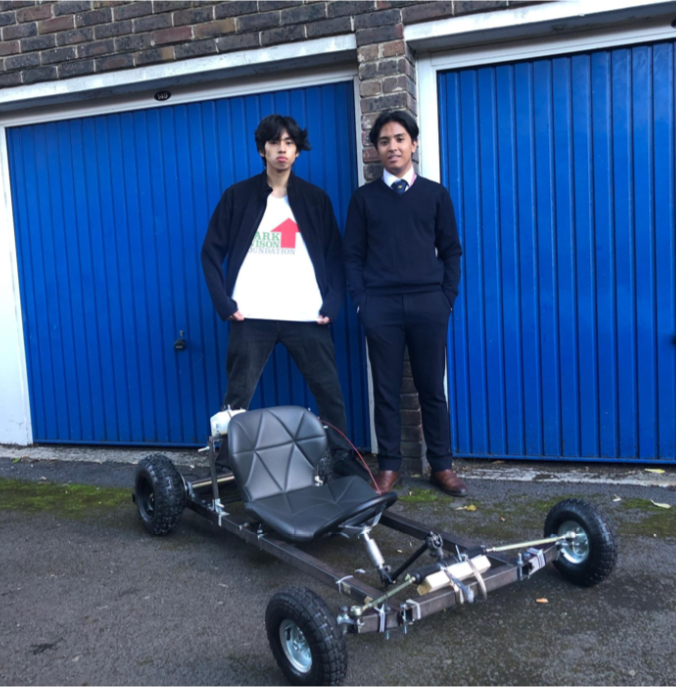
The challenge we had given ourselves was to build a go kart powered by petrol. We started by creating a simple design that would be cost effective while still being strong enough to support itself and the driver. After we had received the funding, we came across our first challenge: the initial pricing of the parts we had planned to buy had increased. This meant that we had to redo our parts list to fit our budget and put in some of our own money into the budget. This included switching to a cheaper metal for the frame, using smaller square tubing for fuel tank mount, and a more complicated steering system.
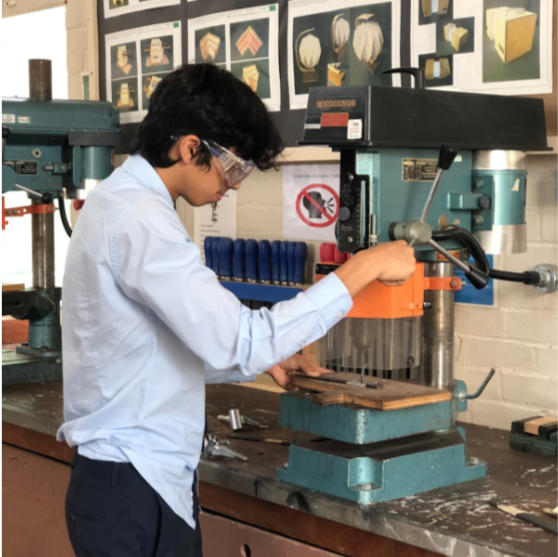
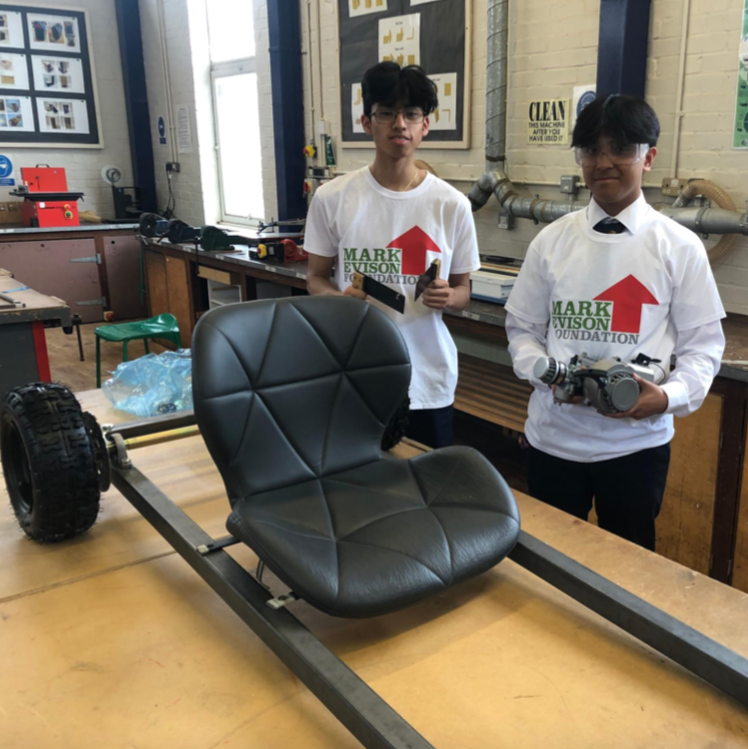
We used our school’s DT workshop for tools. One helpful tip we learnt when marking the holes for drilling was to place masking tape over the metal then use a pencil to precisely mark on where to drill. This allowed us to make our cuts and holes perfect to the closest millimetre. We used angle grinders to cut the square tubing to the correct length and a pillar drill to drill holes into the metal. By mid-July, we had completed the rear section of the frame and attached the rear axle. However, we did not have enough time to complete the go kart as school had finished. We then planned on working on sections which required the school’s specialist tools. Our next step was to bring all the parts to Paul’s house, where he had access to basic tools that we could use to complete the go kart.
We then worked on the frame during the summer holidays by bolting what we could together. We also marked more holes for drilling and sections for cutting. When we reached the point where we could make holes and cuts, we used a hand drill to attempt to drill through the metal. However, this was too weak and ended up overheating. We then switched to a more powerful drill. Paul used a tip which was to lubricate the drill bit with some oil before drilling. This time the drilling was more successful as we were able to make holes in the steel square tubing but it would not be able to make holes in stronger pieces of steel.
This proved to be another challenge as we had to make these holes which are essential to the go kart, but we had no tools to be able to make them. After negotiating a later deadline, the Mark Evison Foundation allowed us one more month to complete our project. This meant that Paul and I would have to work as quickly as we could while maintaining a good standard. We spent multiple afternoons and weekends on the go kart. Being back in school meant we were able to access the strong pillar drill and make the final holes that we needed.
Eventually, we were able to finish the go kart by bringing the last parts to Paul’s house and assembling it in his garage. Seeing the complete product brought us great satisfaction which was a result of months of hard work. Overall, we greatly enjoyed the project as we were able to develop our practical skills and solve problems as we went along. My favourite part of the project was when we first started the engine and had a feel of how the final product would be like. It was also satisfying seeing parts slowly come together to resemble what would be a go kart.