Their story, in their words…
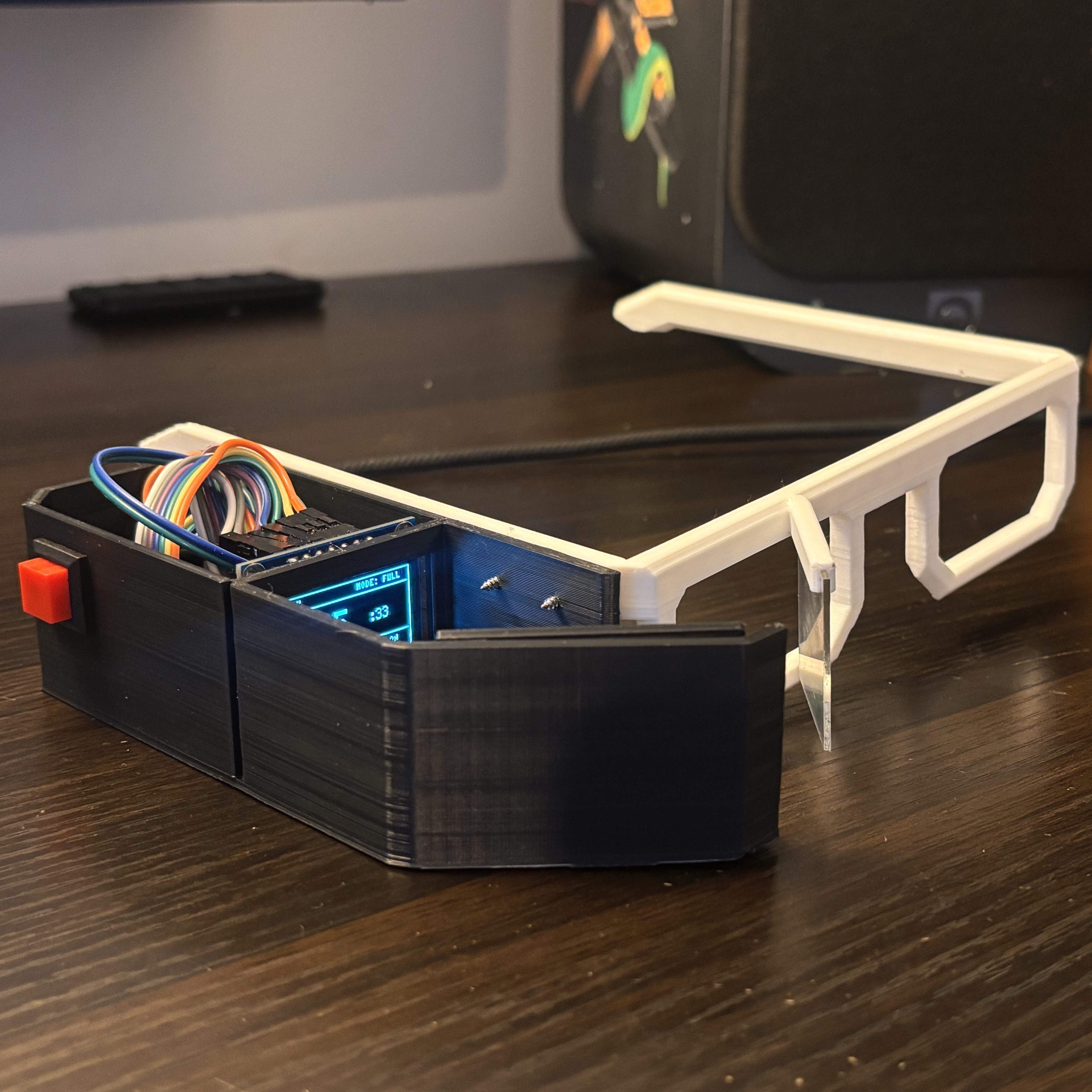
What I did: I set out to build a pair of wearable AR glasses that could project a heads-up display over the real world. The build combined a 3D-printed frame, a micro-OLED screen driven by an Arduino microcontroller and an optics chain (aspheric collimating lens, first-surface mirror, and a 50/50 beam splitter) to route the display image into the wearer’s field of view.
How it worked out: The electronics side had a rocky start.
I started off trying to use a 3.3V arduino pro mini however the adapter I had to use to connect it to my laptop wasn’t working. After weeks of trying to get it to work I decided to use a spare arduino nano I had lying around, offering the same functionality. The only drawback was its new 5v required, meaning I could no longer use the small battery. In the end I solved this by using a portable powerbank with a usb cable, allowing the user to still be mobile.
Alongside this, my first attempt at driving the OLED over hardware SPI produced nothing but scrolling static — the standard display library wasn’t issuing a reliable reset pulse. Switching to the U8g2 library with software SPI fixed that, giving me full control over the signal timing. I also had issues uploading any code at all, I traced it to a bootloader mismatch on the board I used to communicate with the microcontroller, solved by forcing the older bootloader profile during upload. Once past those hurdles, I had a stable, working display.
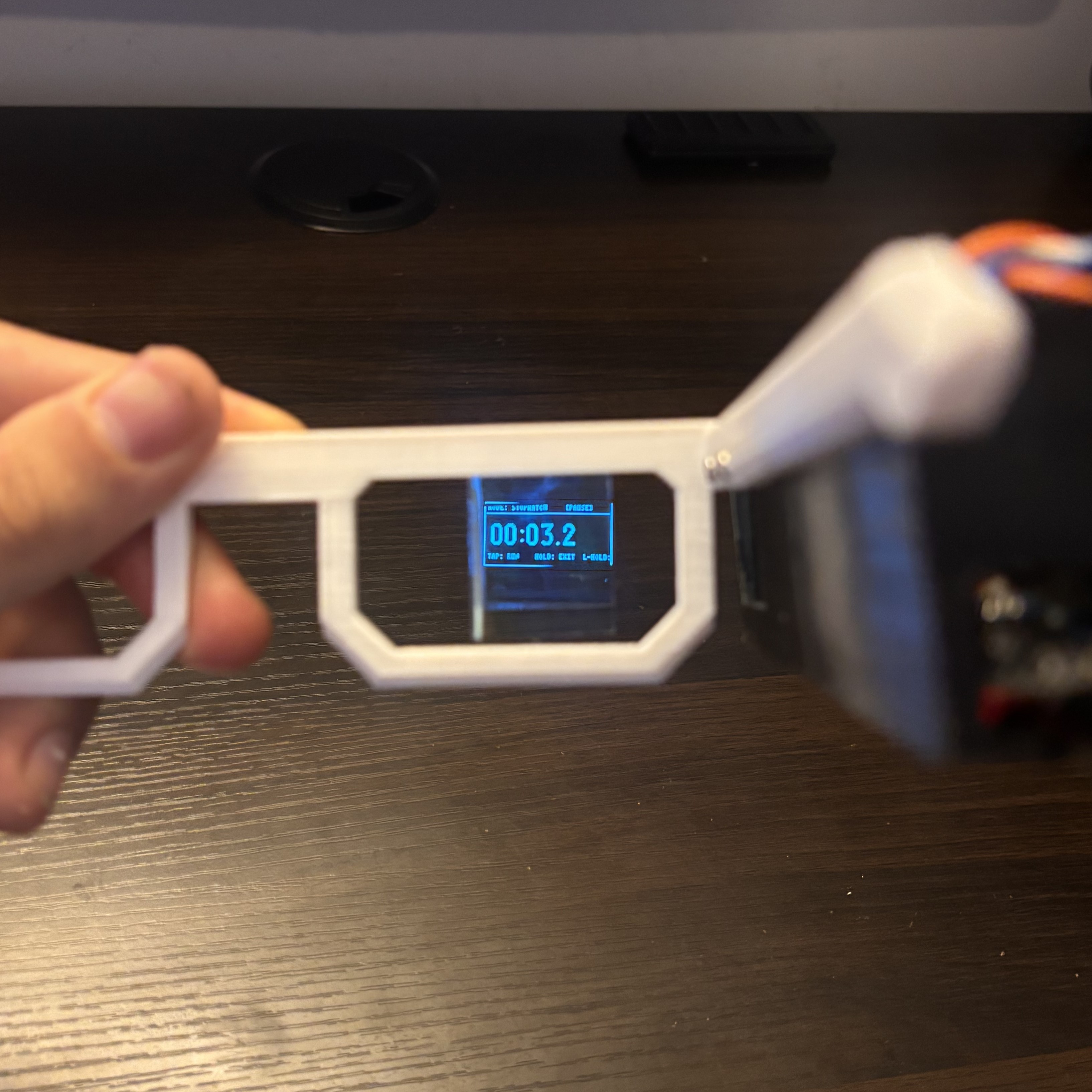
Getting the optics — collimating and aligning the image through the beam splitter — was the harder, more finicky part of the project, and easily where I learned the most. It required multiple iterations of 3D CAD modeling and test prints. After persistent fine-tuning, the final model successfully projected a sharp, readable overlay without obstructing natural vision. After many design tweaks and failed 3d prints, it was a great feeling to finally get a clear overlay and all the parts working together nicely
Once all this was working, I finally moved on to software and after a little bit of trial and error, I believe I created an OS that effectively used the one button and small screen present in the glasses, offering extra functionalities such as a stopwatch.
How I felt about it: Genuinely challenging in a way my previous projects hadn’t been. I’ve built electronics and written software before, but optics was completely new to me, and there were points where I was debugging blind — not sure if a problem was in my code, my wiring, or my optical alignment. Getting the display working cleanly after several failed approaches was one of the most satisfying “it finally works” moments I’ve had.
What I got out of it: Beyond the technical skills like my improvement in embedded C++ and systematic hardware debugging — this project pushed me to work across fields I hadn’t combined before: mechanical design (the frame), electronics, firmware, and optics all had to work together. It was a lot of fun and id like to again thank the Mark Everson Foundation for enabling me to undertake this project.