Their story, in their words…
Developing a 1U CubeSat Engineering Prototype for Low Earth Orbit (LEO) Climate Observation
When I first started this project, I had very little experience with satellite design and electronics, so building my own CubeSat inspired prototype was a big challenge for me. My aim was to create a small prototype that could measure infrared radiation, similar to the thermal radiation leaving the Earth, and use this to explore h ow satellites can help us understand climate change.
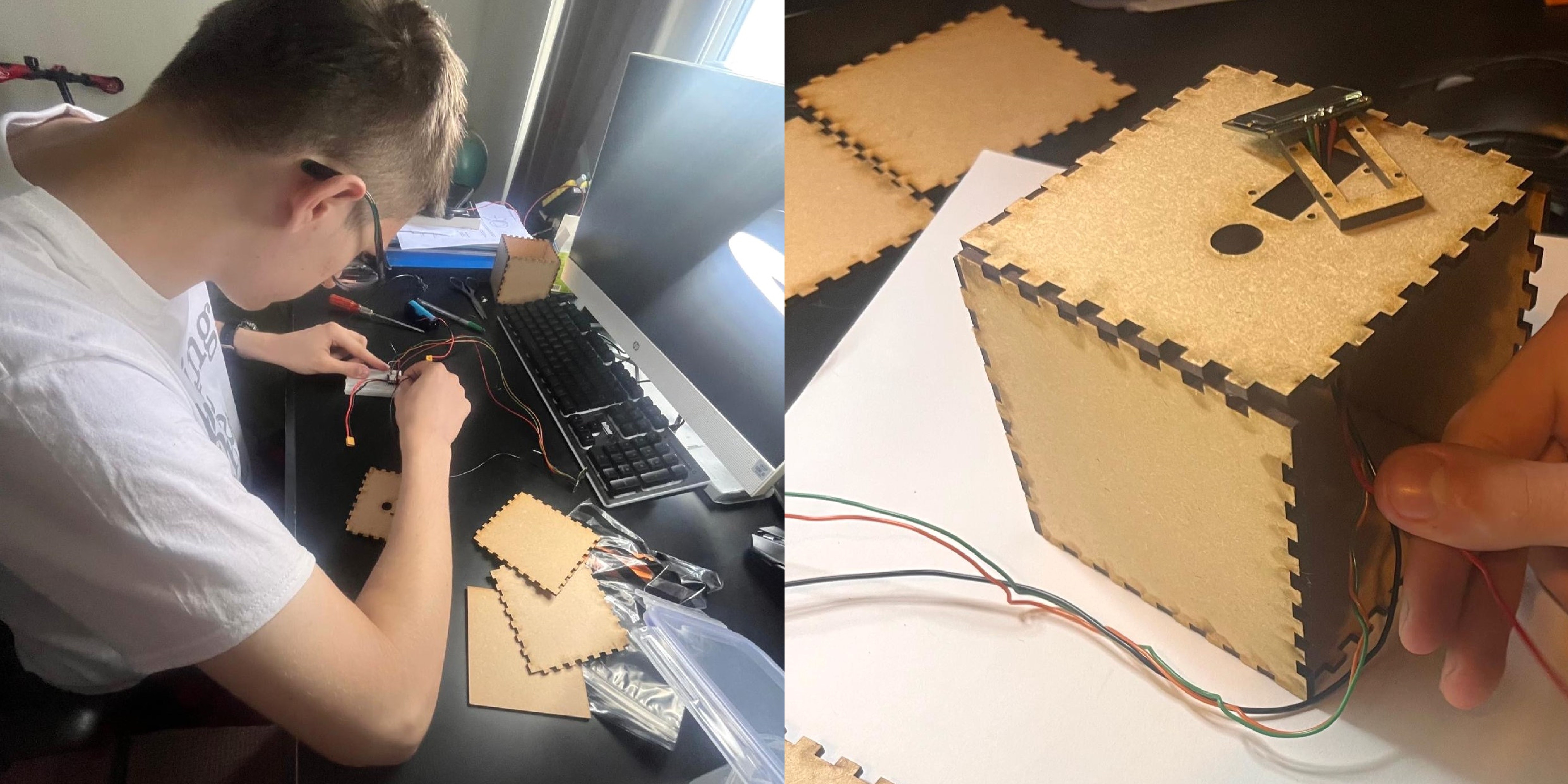
For my project I used a XIAO microcontroller, thermopile sensor and an OLED display. The thermopile was used to measure infrared radiation, and the XIAO processed the data so that the results could be displayed on the OLED. I also designed and built the CubeSat structure, meaning that I had to consider how all of the electronics would fit inside a small enclosure.
One thing I underestimated was how much time I would spend fixing problems. The project definitely didn’t work perfectly the first time! I had problems with wiring, getting components to communicate with each other and at one point my thermopile was only returning “NaN” instead of actual measurements. I also had problems with getting the OLED to display and update the results properly. This meant that I had to test different parts of my circuit individually and make changes to my code and wiring until I could identify what was causing each problem.
This was frustrating at times, especially when something quite small took a long time to fix. However, it also made me feel much more satisfied when I finally got the thermopile measurements to appear on the OLED. Seeing something that I had originally planned through drawings and circuit diagrams actually working was probably my favourite part of the project.
The biggest thing I got out of this project was learning how much problem solving is actually involved in engineering. Before starting, I had minimal experience with this type of electronics. I now have much more experience with microcontrollers, sensors, wiring and Arduino, but I have also learnt that things will not always work as expected and you have to be willing to keep testing different solutions.
Most importantly, this project has made me even more interested in aerospace engineering. It gave me an opportunity to combine Maths, Physics and Computer Science into one practical project and learn about an area of engineering that I would like to pursue in the future.