
Their story, in their words…
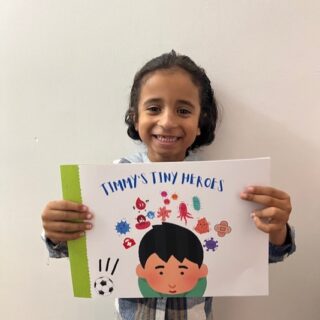
For my project, I created a children’s book called Timmy’s Tiny Heroes. The story follows Timmy, a little boy who scrapes his hand while playing outside. What could have been just a small accident turns into an adventure inside his body, where an amazing superhero team—red blood cells, platelets, and white blood cells—spring into action to heal him and fight off germs. I wrote the text in rhyme to make it fun and memorable for young readers, and I designed bold, colourful illustrations to bring the characters to life.
The process of creating the book involved more than simply writing a story. I had to think carefully about how to explain scientific ideas—like the roles of blood cells—in a way that children would understand and enjoy. I made each part of the immune system into a hero: the platelets became Stick and Patch, the white blood cells became the Germ Police, and the red blood cells rushed around like speedy couriers. By personifying the science, I turned biology into an adventure.
It worked out even better than I hoped. Children responded with excitement and laughter when they read the story, and they quickly picked up on the scientific concepts without feeling like they were “learning a lesson.” Teachers and parents also commented that the book was both fun and educational, which showed me that my approach had succeeded. I wanted children to leave the story with not only entertainment but also an understanding of how amazing their own bodies are—and from their reactions, I believe that goal was achieved.
How did I feel during this project? At first, I felt nervous: writing and illustrating a book is a big challenge, and I wasn’t sure I could balance accuracy with creativity. But as the story developed, I felt more and more proud. Seeing the characters come alive on the page gave me confidence, and when I shared the final version, I felt a strong sense of accomplishment. It was rewarding to know that my idea could inspire joy and curiosity in others.
What I got out of this project was much more than just a finished book. I learned how to simplify complex science without losing its meaning, a skill that will be valuable in many areas of life. I discovered how powerful stories can be in teaching and in shaping how people—especially children—see themselves and their world. On a personal level, I also developed resilience: there were moments when the rhymes felt impossible or the illustrations didn’t look right, but pushing through those challenges made the final result even more meaningful.


