Their story, in their words…
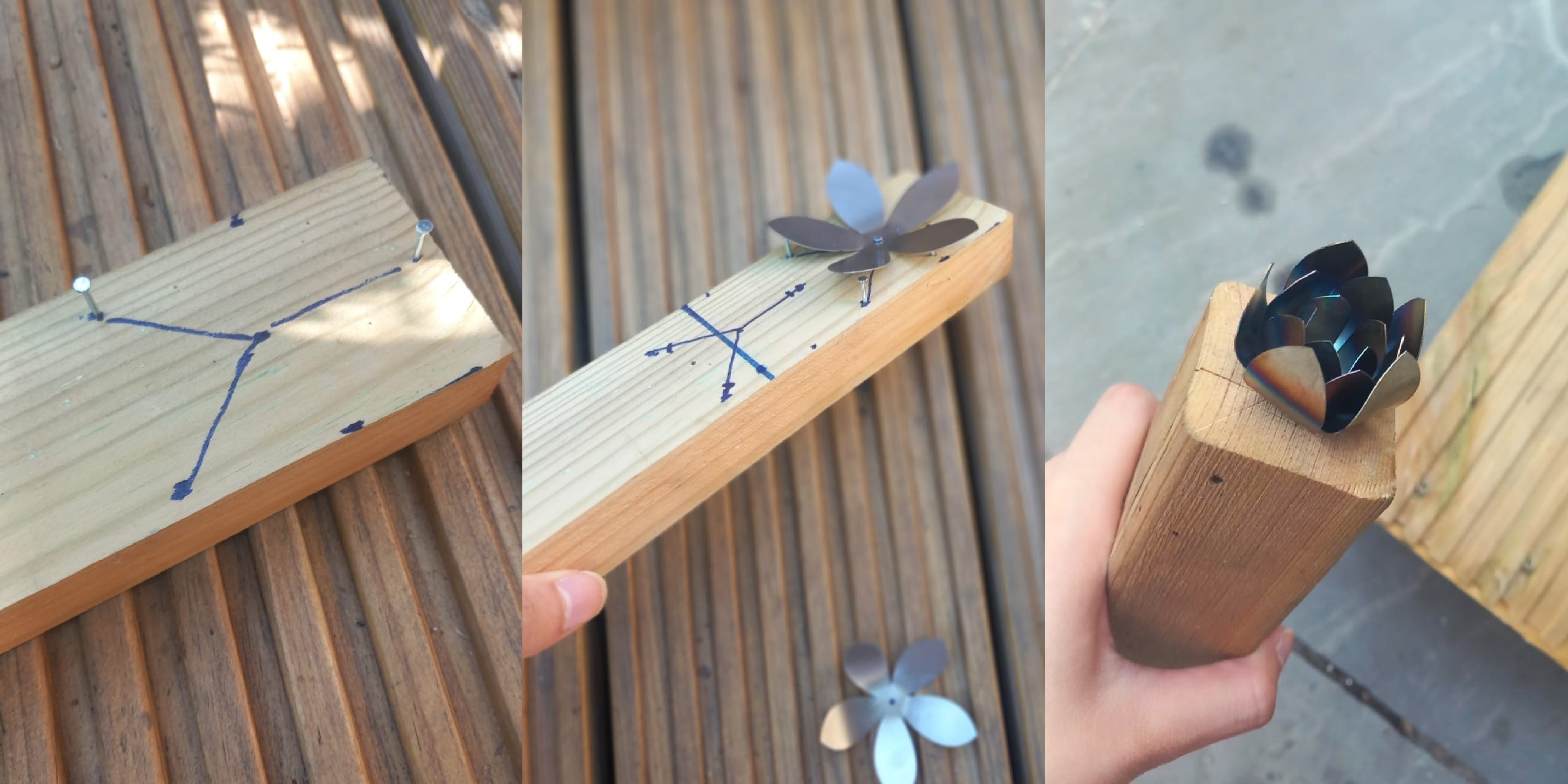
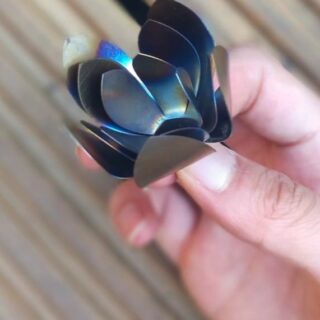
What we did: Like how we originally planned, we had the SMA (shape memory alloy) metal laser cut to 3 layers of petals which were connected by the base by nailing it to a block of wood. In the photos, it displays the before and after moments of the training process in which we used a blowtorch to heat it to shape. We required a few nails to hold the metal in place while training to prevent it flattening and in the linked video, it showed the successful final product which demonstrated the special properties of SMA metal.
We also hosted a showcase to 3 year 7 classes which we allowed students to witness the blooming process of the metal when heated and educated them with the technicality of the reason for the special property of the metal. We received a lot of interest and curious questions which resulted in more attraction to our fundraising event. Moreover, operating during hot weather earned the team a sum of money by selling ice lollies and chilled drinks.
How it worked: Between states (solid, liquid, gas), particles move around when heat is applied or taken away. A similar thing happens in a solid. With enough heat, the lattice structure of the solid can change. The ability to remember that structure and return to it is what gives a material shape memory properties.
In the case of SMA, there are 2 structures known as Austenite (face centered cubic) and Martensite (body centered cubic). When heated past the threshold temperature, SMA changes from martensite to austenite. Regardless of the extent of deformation in the martensite form, the material will always return to the same structure when heated.
There are 2 types of transformation in a lattice. Diffusion is where the particles randomly vibrate and eventually move to a vacant position. By doing this, it leaves an empty space for a separate particle to move into. Essentially, two particles swap positions. The other type is displacement, which is what happens in SMA. It is when layers of particles all shift in the direction of the force. Similar to lines of soldiers moving together. This means a particle’s neighbour would still be the same after the transformation.
How it felt: Zoey: Besides the fact that it was a challenging process which brought lots of relief when we succeeded, I enjoyed the process of the slight trial and error process of determining the placement and heights of the nails. As the nails needed to be on similar heights and distances from the middle, the team had to plan out the layout and also physically check if it was to desired results. From my perspective, this process was a carefree but requires precise operation as it did not have lasting effects to the product but still utilising our understanding of the metal. Overall I appreciated the strenuous activity as I always had the passion for difficult questions.
Alexia: One way I was able to benefit from our project was through our research of the cultural aspect of the lotus flower. As a group, we were able to plan not just the engineering and technical side of the project, but also the cultural side. Learning about the importance and symbolism of the lotus flower, and the significance of it between different countries. We were able to develop our understanding on how the lotus flower was incorporated in religion, food and history in Vietnam, China, and more.
Chi Mai: It was interesting to learn about how a seemingly “magical” material actually works. I also learn how to train the material so it returns to a desired shape. This meant developing workshop and problem solving skills. Many initial ideas did not work. This slow learning experience means I can approach future projects with more confidence. Additionally, this project allowed me to engage in an interest of mine – researching history and culture. I got to know more about the deeper complexities within and between Asian culture, as the lotus symbol is frequently packaged down to be made marketable in recent years.
What we got out of it: Developing our understanding of the physics of different metals and furthering our cognitive ability to plan were certain given the fact that we were working with an metal which was not taught in our school curriculum but the most unexpected aspect we came across was the importance of including every aspect of the project into one singular body. While devising each section like the fundraising or cultural representation into smaller steps were simple, it was eye opening to see the necessity to ensure the balance between each section to prevent burning out on a specific part. The perseverance we had learnt was truly our most valuable lesson.