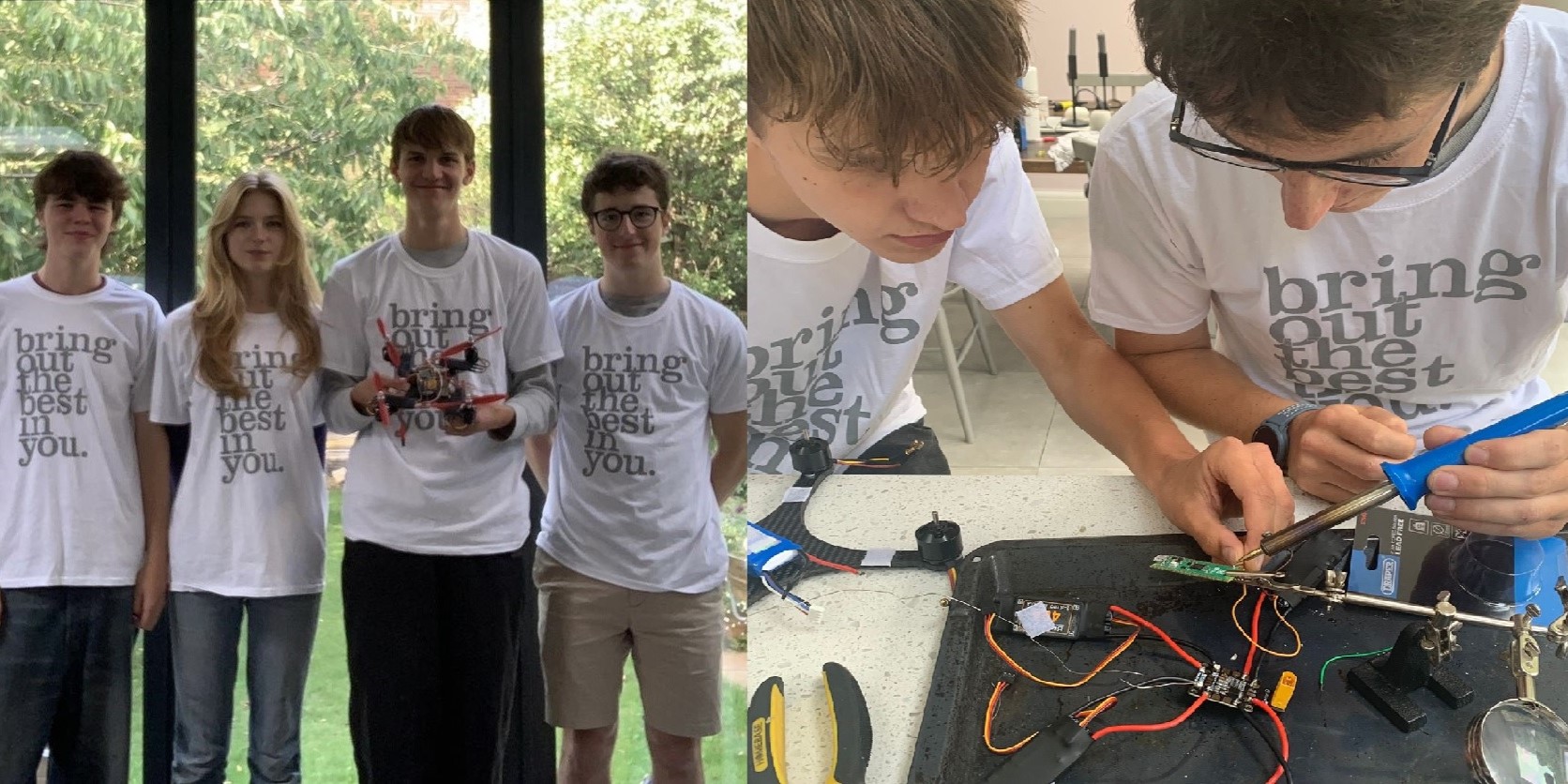
Their story, in their words…
For our Mark Evison project, we built a Quadcopter. This was our first time taking on an engineering project like this and it came with many challenges.
The quadcopter consisted of a carbon fibre base with 4 limbs. In order to control the drone we coded a raspberry pi pico 2 that communicates with our four electronic speed controllers to control the motors and therefore the propellers. Powering the drone was a lightweight Li-Po battery and a Matek power distribution board.
Initially, we started by having meetings where we discussed design ideas, did the maths for the electronics and researched and learned about new topics. After consolidating ideas, we started ordering parts and planning construction. Then, we got the carbon base cut out using a CNC-router at school, we drilled holes in it and attached all the motors. Following this, we soldered all our components together and began to work on the code. Once assembly was complete, we could test our code and see how it affected the components individually to ensure a successful maiden flight.
On launch day, we ran final tests to make sure all the components were working. We did our first test flight in Morden Hall Park. The drone successfully took off however the wind caused it to pitch too much and crash into the ground. Despite the rough ending, this launch was still a major success and we are happy with the outcome of this project.
One of the initial struggles of the project was ordering all of the correct components for our drone. We needed to do some calculations for how much thrust we would need for the weight of the quadcopter and had to make sure all the parts that we are ordering are suitable for this. A large amount of time had to be dedicated to researching and finding the right element in order to overcome this.
During construction, there were many problems that arose. Due to a mistake in the cutting of the carbon fibre, the base was smaller than we had planned. This made it much harder to secure the motors as well as having far less space for the components. After a re-evaluation, we used longer screws to attach the motors and found some velcro strips to fasten the electronics. This helpful change made working on the drone much easier as parts could be swiftly removed if required.
An ongoing issue we found was time management. Finding a time when we were all free to have a meeting was sometimes a struggle. We also had weeks where we would work on the drone most days and weeks where none of us would think about it. If we were to ever do a project like this again, we would set stricter, more frequent deadlines as well as having days planned in advance for all of us to work on it.
Thank you so much Mark Evison for providing us this opportunity. As a team we have all gained some incredibly valuable and varied skills. But most importantly, this has been such a fun and rewarding experience.